Gender Selection
Last updated: September 2026 | Reviewed by: HayatMedTour Medical Team
Gender selection, also known as sex selection, is a medical process that allows couples to choose the sex of their child before pregnancy. Using advanced techniques such as PGD (Preimplantation Genetic Diagnosis) combined with IVF, couples can determine the sex of an embryo with up to 99% accuracy before it is transferred to the uterus. Iran is one of the few countries where gender selection is legally permitted for both medical reasons and family balancing, attracting couples from across the Middle East, Asia, and beyond.
What is gender selection?
Having a healthy child is one of the greatest desires of every couple. But in many cases, knowing the sex of the embryo is also very important. Sometimes, couples want to know the sex of the embryo before the pregnancy to prevent serious genetic diseases and chromosomal abnormalities. For example, genetic diseases such as muscular dystrophy and hemophilia in parents affect only boys, and autism often occurs more severely in boys than in girls.
In addition to medical issues, some parents choose a particular gender for childbearing for cultural, social, and even economic reasons, as well as family balancing. Sometimes couples try to conceive to have a child of the desired sex, which, in addition to imposing considerable costs, also endangers the mother’s health. Therefore, determining the sex of the fetus has been a topic of concern for families from the past to the present, and several traditional and scientific methods have been proposed for it. In this article, we discuss the different methods of sex selection.

How do we determine the gender of the embryo?
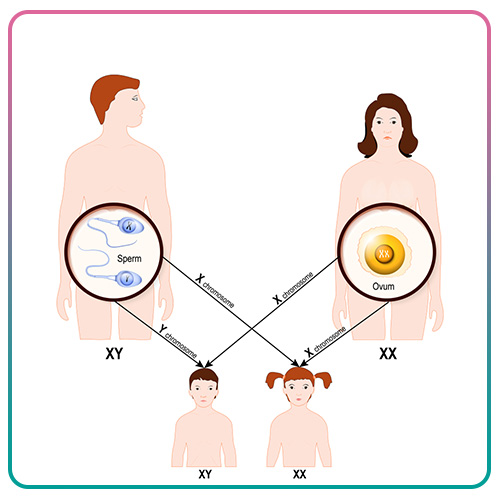
The sex of the embryo is determined by the sex chromosomes of the sperm, not the egg. Every egg carries an X chromosome, while sperm can carry either an X or a Y chromosome. When a Y-carrying sperm fertilizes the egg, the result is a boy (XY). When an X-carrying sperm fertilizes the egg, the result is a girl (XX).
The characteristics of sperm containing X and Y chromosomes are so different that several traditional and scientific methods for determining the sex of the fetus have emerged due to these differences. These differences are:
- Sperm containing the Y sex chromosome is smaller than sperm containing the X chromosome and moves at a higher speed.
- Sperm containing the X chromosome can survive in the vaginal environment for 4 to 5 days, while sperm containing the Y chromosome can survive in the vaginal environment for a maximum of 16 to 18 hours.
- Sperm containing the Y chromosome survive better in an alkaline environment.
Gender selection methods
Numerous methods have been used to determine the sex of the fetus from the past to the present, which have different accuracy and efficiency.
Some of these methods are traditional methods that are generally proposed experimentally, and due to the different characteristics of sperm containing the X chromosome and the Y chromosome, are not accurate enough.
Traditional methods of determining gender include the following:
Proper diet
Foods affect the pH of the uterus and vagina, so nutrition can play an important role in determining the sex of the fetus. Foods containing sodium, phosphorus, iron, potassium, and zinc, such as pistachios, dates, strawberries, figs, spinach, chocolate, bananas, etc., increase the pH of the uterus and increase the chances of the fetus becoming a boy.
On the other hand, the use of foods containing calcium, magnesium, and copper, such as dairy products, cabbage, mushrooms, barley, walnuts, eggs, pasta, etc., reduces the pH of the uterus and increases the likelihood of the formation of a female fetus.
Setting the intercourse time
Since the uterine environment is more alkaline at the time of ovulation, and the sperm containing the Y chromosome survives better in the alkaline environment if intercourse takes place around the time of ovulation, the chances of the fetus becoming a boy increase. If intercourse takes place two days before or after ovulation, the chances of the fetus becoming a girl increase. Today, with the advancement of science, more scientific and effective methods are used to determine the sex of the fetus, which are more accurate.
Gender selection by PGD with IVF
The PGD technique is the only method that can guarantee the sex of the desired fetus. In this method, couples are treated with assisted reproductive technology selection. After stimulating ovulation and taking the egg from the mother (or Donated Egg) and taking the sperm from the father, the eggs are fertilized with the sperm in the laboratory.
After 3 days of embryo formation, a specialist doctor makes a laser incision in the fetal membrane, separates one of the 6 to 8 embryonic cells without damaging the other cells, and determines the sex of the fetus by molecular methods. The desired sex of the embryo is then transferred to the mother’s uterus after in vitro culture to continue growth. The accuracy of this method in determining the sex of the embryo is more than 97%. This method requires advanced equipment that is available in infertility treatment centers in Iran and can be done with high accuracy.
Is it possible to determine the gender of frozen embryos?
Usually, determining the gender of the embryos by PGD is done before freezing them. But after freezing the embryos, it is also possible to determine their gender.
To determine the gender of frozen embryos, the embryos are thawed, and a PGD test is performed on them to determine the gender of the embryos.
Finally, the embryo that has the selected gender is transferred to the mother’s womb, and the rest of the embryos are frozen again.
Gender selection by sperm separation method
In this method, at first, the sperm are washed using a special method in the laboratory, and then a centrifuge is used to separate the sperm containing X and Y chromosomes. With controlled rotation, the sperm sample is divided into different layers based on particle density. Sperm containing the X chromosome are denser than sperm containing the Y chromosome and are in one layer, and sperm with the Y chromosome, which are lighter, are in the other layer. After the sperm are separated, a sperm sample with the desired sex chromosome is used to fertilize the egg. IVF or IUI can be used to fertilize the egg with the advice of a specialist. The success rate of this method for determining gender is between 70 and 85%.
Learn more about ways to increase sperm quality: How to Increase Male Fertility With Healthy Sperm
Who is a Good Candidate for Gender Selection?
Gender selection by genetic examination is suitable for two main groups of people:
1. Medical Reasons
Some genetic diseases are linked to the sex of the child. Couples who carry genes for sex-linked conditions such as hemophilia, Duchenne muscular dystrophy, or fragile X syndrome may choose gender selection to prevent passing these conditions to their child. In these cases, PGD not only determines the sex of the embryo but also screens for the genetic condition itself, giving couples the best chance of having a healthy baby.
2. Family Balancing
Couples who already have one or more children of the same sex and wish to have a child of the opposite gender are also strong candidates. This is known as family balancing, a deeply personal choice that many couples pursue after having two or three children of the same gender. Iran is one of the few countries where gender selection for family balancing is legally permitted and widely practiced using PGD with IVF.
General requirements for candidates:
- The woman must be able to undergo ovarian stimulation and egg retrieval
- The couple must produce viable embryos for PGD testing
- Age is a factor; younger women typically produce more eggs, increasing the chances of having embryos of the desired sex available for transfer
- Couples with a history of IVF failure or recurrent miscarriage may also benefit from PGD alongside gender selection
Gender Selection in Iran
Since the success rate of sex selection by the PGD method is very high, in Iranian infertility treatment centers, only the PGD method, along with IVF, is used to determine the sex of the embryos. Every year, many couples travel to Iran to use gender selection services by IVF for family balancing.
Some parents dream of having both a boy and a girl to experience the joys of raising children of each gender. In such cases, IVF and gender selection offer a safe, reliable way to increase the chances of having a child of the desired gender, without relying on chance or unproven traditional methods.
In addition to the high success in determining gender and using up-to-date and advanced equipment in Iranian infertility treatment centers, the low cost of services in Iran has caused many couples who want to choose the sex of their fetus to travel to Iran from around the world.
Gender Selection Success Rates in Iran
| Method | Success Rate (Girl) | Success Rate (Boy) | Recommended |
|---|---|---|---|
| PGD with IVF | 97% – 99% | 97% – 99% | ✓ Yes |
| Sperm Division | 73% – 75% | 78% – 85% | Limited use |
| Traditional Methods | ~50% | ~50% | ✗ Not reliable |
Note: Success rates reflect gender determination accuracy, not IVF pregnancy success rates. PGD with IVF is the only method used at fertility centers in Iran for gender selection.
The cost of gender selection in Iran
The cost of the PGD test on embryos for gender selection in Iran is about $1,500-$2,500. Since the technique of determining the sex of the embryo is performed along with IVF, the cost of IVF (assisted reproduction) should be added to this cost. The cost of IVF treatment in advanced medical centers in Iran is about $ 2,500 – $ 4,200.
The cost of PGD gender selection for family balancing depends on the number of embryos and the center where the treatment will be done. We offer 2 packages for IVF and gender selection in Iran:

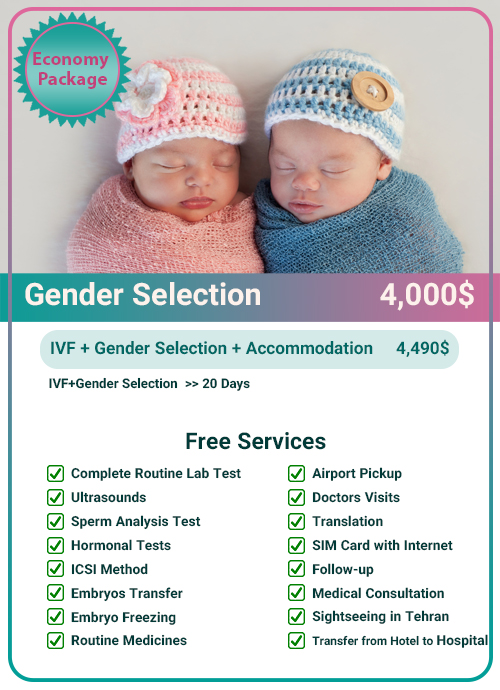
Contact us for more information about gender selection for family balancing in Iran, as well as infertility treatments and procedures in Iran.
References
- • Sermon K, et al. “Preimplantation genetic diagnosis.” The Lancet, 2004. pubmed.ncbi.nlm.nih.gov
- • Zegers-Hochschild F, et al. “The International Glossary on Infertility and Fertility Care.” Fertility and Sterility, 2017. pubmed.ncbi.nlm.nih.gov
- • Practice Committee of the ASRM. “Preimplantation genetic testing: a Practice Committee opinion.” Fertility and Sterility, 2018. pubmed.ncbi.nlm.nih.gov
- • Ericsson RJ, Langevin CN, Nishino M. “Isolation of fractions rich in human Y sperm.” Nature, 1973. pubmed.ncbi.nlm.nih.gov
- • Mayo Clinic. “Preimplantation genetic diagnosis (PGD).” mayoclinic.org
- • WHO. “Medical genetics services in Iran.” who.int
Frequently Asked Questions About Gender Selection in Iran
Is gender selection legal in Iran?
Yes. Unlike many countries, Iran legally permits gender selection both for medical reasons and for family balancing. This makes Iran one of the most accessible destinations in the world for couples who wish to choose the sex of their child through PGD and IVF
How accurate is PGD for gender selection?
PGD (Preimplantation Genetic Diagnosis) is the most accurate method available, with a success rate of 97% to 99%. It is performed before the embryo is transferred to the uterus, making it the only method that can guarantee the sex of the fetus with near-certainty.
How long does the gender selection process take in Iran?
The full IVF with PGD cycle typically takes 3 to 4 weeks from the start of ovarian stimulation to embryo transfer. Most couples plan a 3- to 5-week stay in Tehran to complete the process. HayatMedTour assists with all coordination, including accommodation and hospital appointments.
How long does the gender selection process take in Iran?
The full IVF with PGD cycle typically takes 3 to 4 weeks from the start of ovarian stimulation to embryo transfer. Most couples plan a 3- to 5-week stay in Tehran to complete the process. HayatMedTour assists with all coordination, including accommodation and hospital appointments.
What is the cost of gender selection in Iran?
The cost of PGD for gender selection in Iran ranges from $1,500 to $2,500, depending on the number of embryos tested. Since PGD is performed as part of an IVF cycle, the total cost, including IVF, is approximately $4,000 to $6,700. This is significantly lower than the cost of the same procedure in Europe or North America.
Can gender selection be done with frozen embryos?
Yes. If you already have frozen embryos stored at a clinic, they can be thawed and tested with PGD to determine their sex. The embryo of the desired gender is then transferred to the uterus, and the remaining embryos are refrozen. This option is available at fertility centers in Tehran.
What happens if no embryos of the desired sex are available
This is a possibility that couples should be prepared for. If all viable embryos are of the same sex, your fertility specialist will discuss the options with you, which may include a second IVF cycle or transferring the healthiest available embryo regardless of sex. This is why producing a sufficient number of embryos during stimulation is important.
Is gender selection different from PGT-A (chromosomal screening)?
PGD for gender selection and PGT-A (Preimplantation Genetic Testing for Aneuploidies) are related but different. PGT-A screens all chromosomes for abnormalities to select the healthiest embryo, while PGD for gender selection specifically identifies the sex chromosomes (XX or XY). Many couples choose to combine both tests in one cycle for the best outcome.

Written & Reviewed by
HayatMedTour Medical Team
Our content is prepared and reviewed by a team of certified fertility specialists based in Tehran, Iran, with extensive experience in fertility treatment.
 https://hayatmedtour.com/wp-content/uploads/2026/05/Essential-Pre-Pregnancy-Tests-1.jpg
630
1200
hayatfa
https://hayatmedtour.com/wp-content/uploads/2019/08/HayatMedTour-logo.png
hayatfa2026-05-31 15:00:252026-06-13 16:35:40Essential Pre-Pregnancy Tests
https://hayatmedtour.com/wp-content/uploads/2026/05/Essential-Pre-Pregnancy-Tests-1.jpg
630
1200
hayatfa
https://hayatmedtour.com/wp-content/uploads/2019/08/HayatMedTour-logo.png
hayatfa2026-05-31 15:00:252026-06-13 16:35:40Essential Pre-Pregnancy Tests https://hayatmedtour.com/wp-content/uploads/2026/02/Egg-Freezing-and-Fertility-Preservation.jpg
220
350
hayatfa
https://hayatmedtour.com/wp-content/uploads/2019/08/HayatMedTour-logo.png
hayatfa2026-05-12 10:37:182026-07-18 17:33:22Egg Freezing and Fertility Preservation
https://hayatmedtour.com/wp-content/uploads/2026/02/Egg-Freezing-and-Fertility-Preservation.jpg
220
350
hayatfa
https://hayatmedtour.com/wp-content/uploads/2019/08/HayatMedTour-logo.png
hayatfa2026-05-12 10:37:182026-07-18 17:33:22Egg Freezing and Fertility Preservation https://hayatmedtour.com/wp-content/uploads/2025/10/Egg-Retrieval-Process.jpg
220
350
hayatfa
https://hayatmedtour.com/wp-content/uploads/2019/08/HayatMedTour-logo.png
hayatfa2025-10-07 09:10:262026-06-13 16:57:23Egg Retrieval in IVF: Process, Steps, and Aftercare
https://hayatmedtour.com/wp-content/uploads/2025/10/Egg-Retrieval-Process.jpg
220
350
hayatfa
https://hayatmedtour.com/wp-content/uploads/2019/08/HayatMedTour-logo.png
hayatfa2025-10-07 09:10:262026-06-13 16:57:23Egg Retrieval in IVF: Process, Steps, and Aftercare https://hayatmedtour.com/wp-content/uploads/2025/09/How-can-you-improve-your-uterine-health.jpg
220
350
hayatfa
https://hayatmedtour.com/wp-content/uploads/2019/08/HayatMedTour-logo.png
hayatfa2025-09-07 14:40:292026-06-13 16:57:58How can you improve your uterine health?
https://hayatmedtour.com/wp-content/uploads/2025/09/How-can-you-improve-your-uterine-health.jpg
220
350
hayatfa
https://hayatmedtour.com/wp-content/uploads/2019/08/HayatMedTour-logo.png
hayatfa2025-09-07 14:40:292026-06-13 16:57:58How can you improve your uterine health? https://hayatmedtour.com/wp-content/uploads/2025/06/Why-Do-Some-Embryos-Stop-Growing-During-IVF.jpg
220
350
hayatfa
https://hayatmedtour.com/wp-content/uploads/2019/08/HayatMedTour-logo.png
hayatfa2025-06-08 11:31:192026-06-13 16:58:33Why Do Some Embryos Stop Growing During IVF?
https://hayatmedtour.com/wp-content/uploads/2025/06/Why-Do-Some-Embryos-Stop-Growing-During-IVF.jpg
220
350
hayatfa
https://hayatmedtour.com/wp-content/uploads/2019/08/HayatMedTour-logo.png
hayatfa2025-06-08 11:31:192026-06-13 16:58:33Why Do Some Embryos Stop Growing During IVF? https://hayatmedtour.com/wp-content/uploads/2025/05/When-is-Hysteroscopy-Needed.jpg
220
350
hayatfa
https://hayatmedtour.com/wp-content/uploads/2019/08/HayatMedTour-logo.png
hayatfa2025-05-14 22:01:562026-06-14 07:21:54When is Hysteroscopy Needed?
https://hayatmedtour.com/wp-content/uploads/2025/05/When-is-Hysteroscopy-Needed.jpg
220
350
hayatfa
https://hayatmedtour.com/wp-content/uploads/2019/08/HayatMedTour-logo.png
hayatfa2025-05-14 22:01:562026-06-14 07:21:54When is Hysteroscopy Needed? https://hayatmedtour.com/wp-content/uploads/2025/03/Frequently-Asked-Questions-About-IVF.jpg
220
350
hayatfa
https://hayatmedtour.com/wp-content/uploads/2019/08/HayatMedTour-logo.png
hayatfa2025-04-15 09:55:142026-06-14 07:23:0312 Common Questions About IVF
https://hayatmedtour.com/wp-content/uploads/2025/03/Frequently-Asked-Questions-About-IVF.jpg
220
350
hayatfa
https://hayatmedtour.com/wp-content/uploads/2019/08/HayatMedTour-logo.png
hayatfa2025-04-15 09:55:142026-06-14 07:23:0312 Common Questions About IVF https://hayatmedtour.com/wp-content/uploads/2025/02/The-Role-of-Diet-and-Nutrition-in-Fertility-Treatment-Success.jpg
220
350
hayatfa
https://hayatmedtour.com/wp-content/uploads/2019/08/HayatMedTour-logo.png
hayatfa2025-03-03 22:00:002026-06-14 07:23:46The Role of Diet and Nutrition in Fertility Treatment Success
https://hayatmedtour.com/wp-content/uploads/2025/02/The-Role-of-Diet-and-Nutrition-in-Fertility-Treatment-Success.jpg
220
350
hayatfa
https://hayatmedtour.com/wp-content/uploads/2019/08/HayatMedTour-logo.png
hayatfa2025-03-03 22:00:002026-06-14 07:23:46The Role of Diet and Nutrition in Fertility Treatment Success https://hayatmedtour.com/wp-content/uploads/2025/02/preparation-for-IVF.jpg
220
350
hayatfa
https://hayatmedtour.com/wp-content/uploads/2019/08/HayatMedTour-logo.png
hayatfa2025-02-24 22:00:002026-06-14 07:44:07How to prepare for IVF?
https://hayatmedtour.com/wp-content/uploads/2025/02/preparation-for-IVF.jpg
220
350
hayatfa
https://hayatmedtour.com/wp-content/uploads/2019/08/HayatMedTour-logo.png
hayatfa2025-02-24 22:00:002026-06-14 07:44:07How to prepare for IVF? https://hayatmedtour.com/wp-content/uploads/2025/01/Why-choose-Iran-for-infertility-treatment.jpg
220
350
hayatfa
https://hayatmedtour.com/wp-content/uploads/2019/08/HayatMedTour-logo.png
hayatfa2025-02-03 22:00:002026-06-14 07:46:19Why choose Iran for infertility treatment?
https://hayatmedtour.com/wp-content/uploads/2025/01/Why-choose-Iran-for-infertility-treatment.jpg
220
350
hayatfa
https://hayatmedtour.com/wp-content/uploads/2019/08/HayatMedTour-logo.png
hayatfa2025-02-03 22:00:002026-06-14 07:46:19Why choose Iran for infertility treatment? https://hayatmedtour.com/wp-content/uploads/2024/11/Pregnancy-After-40.jpg
220
350
hayatfa
https://hayatmedtour.com/wp-content/uploads/2019/08/HayatMedTour-logo.png
hayatfa2024-11-23 22:00:002026-06-14 07:47:08Pregnancy After 40: Tips for Maximizing Your Chances of Getting Pregnant
https://hayatmedtour.com/wp-content/uploads/2024/11/Pregnancy-After-40.jpg
220
350
hayatfa
https://hayatmedtour.com/wp-content/uploads/2019/08/HayatMedTour-logo.png
hayatfa2024-11-23 22:00:002026-06-14 07:47:08Pregnancy After 40: Tips for Maximizing Your Chances of Getting Pregnant https://hayatmedtour.com/wp-content/uploads/2024/07/Gender-Selection-for-Family-Balancing.jpg
220
350
hayatfa
https://hayatmedtour.com/wp-content/uploads/2019/08/HayatMedTour-logo.png
hayatfa2024-08-06 22:00:002026-06-14 07:49:17Exploring Gender Selection for Family Balancing
https://hayatmedtour.com/wp-content/uploads/2024/07/Gender-Selection-for-Family-Balancing.jpg
220
350
hayatfa
https://hayatmedtour.com/wp-content/uploads/2019/08/HayatMedTour-logo.png
hayatfa2024-08-06 22:00:002026-06-14 07:49:17Exploring Gender Selection for Family Balancing https://hayatmedtour.com/wp-content/uploads/2024/06/The-best-supplements-for-improving-womens-fertility.jpg
220
300
hayatfa
https://hayatmedtour.com/wp-content/uploads/2019/08/HayatMedTour-logo.png
hayatfa2024-06-10 22:00:002026-09-06 16:25:09The Best Supplements for Improving Women’s Fertility
https://hayatmedtour.com/wp-content/uploads/2024/06/The-best-supplements-for-improving-womens-fertility.jpg
220
300
hayatfa
https://hayatmedtour.com/wp-content/uploads/2019/08/HayatMedTour-logo.png
hayatfa2024-06-10 22:00:002026-09-06 16:25:09The Best Supplements for Improving Women’s Fertility https://hayatmedtour.com/wp-content/uploads/2023/11/The-best-supplements-for-improving-mens-fertility.jpg
220
300
hayatfa
https://hayatmedtour.com/wp-content/uploads/2019/08/HayatMedTour-logo.png
hayatfa2023-12-04 22:00:002026-09-06 16:04:33The Best Supplements for Improving Men’s Fertility
https://hayatmedtour.com/wp-content/uploads/2023/11/The-best-supplements-for-improving-mens-fertility.jpg
220
300
hayatfa
https://hayatmedtour.com/wp-content/uploads/2019/08/HayatMedTour-logo.png
hayatfa2023-12-04 22:00:002026-09-06 16:04:33The Best Supplements for Improving Men’s Fertility https://hayatmedtour.com/wp-content/uploads/2023/09/pregnancy-after-premature-menopause.jpg
220
300
hayatfa
https://hayatmedtour.com/wp-content/uploads/2019/08/HayatMedTour-logo.png
hayatfa2023-10-09 22:00:002026-06-14 07:54:21Pregnancy after Premature Menopause
https://hayatmedtour.com/wp-content/uploads/2023/09/pregnancy-after-premature-menopause.jpg
220
300
hayatfa
https://hayatmedtour.com/wp-content/uploads/2019/08/HayatMedTour-logo.png
hayatfa2023-10-09 22:00:002026-06-14 07:54:21Pregnancy after Premature Menopause https://hayatmedtour.com/wp-content/uploads/2023/07/fertility-treatment-options.jpg
220
300
hayatfa
https://hayatmedtour.com/wp-content/uploads/2019/08/HayatMedTour-logo.png
hayatfa2023-07-10 22:00:002026-06-14 07:56:55The Best Fertility Treatment Options
https://hayatmedtour.com/wp-content/uploads/2023/07/fertility-treatment-options.jpg
220
300
hayatfa
https://hayatmedtour.com/wp-content/uploads/2019/08/HayatMedTour-logo.png
hayatfa2023-07-10 22:00:002026-06-14 07:56:55The Best Fertility Treatment Options https://hayatmedtour.com/wp-content/uploads/2023/04/Pregnancy-with-blocked-fallopian-tubes-1.jpg
220
300
hayatfa
https://hayatmedtour.com/wp-content/uploads/2019/08/HayatMedTour-logo.png
hayatfa2023-04-17 22:00:002026-06-14 07:58:09Can you get pregnant with blocked fallopian tubes?
https://hayatmedtour.com/wp-content/uploads/2023/04/Pregnancy-with-blocked-fallopian-tubes-1.jpg
220
300
hayatfa
https://hayatmedtour.com/wp-content/uploads/2019/08/HayatMedTour-logo.png
hayatfa2023-04-17 22:00:002026-06-14 07:58:09Can you get pregnant with blocked fallopian tubes? https://hayatmedtour.com/wp-content/uploads/2023/03/Frozen-Embryo-Transfer.jpg
220
300
hayatfa
https://hayatmedtour.com/wp-content/uploads/2019/08/HayatMedTour-logo.png
hayatfa2023-03-13 22:00:002026-06-14 07:58:52Frozen Embryo Transfer; Advice and Cares
https://hayatmedtour.com/wp-content/uploads/2023/03/Frozen-Embryo-Transfer.jpg
220
300
hayatfa
https://hayatmedtour.com/wp-content/uploads/2019/08/HayatMedTour-logo.png
hayatfa2023-03-13 22:00:002026-06-14 07:58:52Frozen Embryo Transfer; Advice and Cares https://hayatmedtour.com/wp-content/uploads/2023/01/Diminished-Ovarian-Reserve-Causes-Treatment.jpg
220
300
hayatfa
https://hayatmedtour.com/wp-content/uploads/2019/08/HayatMedTour-logo.png
hayatfa2023-01-16 22:00:002026-09-06 16:09:44Pregnancy with Diminished Ovarian Reserve
https://hayatmedtour.com/wp-content/uploads/2023/01/Diminished-Ovarian-Reserve-Causes-Treatment.jpg
220
300
hayatfa
https://hayatmedtour.com/wp-content/uploads/2019/08/HayatMedTour-logo.png
hayatfa2023-01-16 22:00:002026-09-06 16:09:44Pregnancy with Diminished Ovarian Reserve https://hayatmedtour.com/wp-content/uploads/2022/12/أفضل-مراكز-أطفال-الأنابيب-في-طهران.jpg
220
300
hayatfa
https://hayatmedtour.com/wp-content/uploads/2019/08/HayatMedTour-logo.png
hayatfa2022-12-19 22:00:002026-06-14 08:00:31The best IVF centers in Tehran
https://hayatmedtour.com/wp-content/uploads/2022/12/أفضل-مراكز-أطفال-الأنابيب-في-طهران.jpg
220
300
hayatfa
https://hayatmedtour.com/wp-content/uploads/2019/08/HayatMedTour-logo.png
hayatfa2022-12-19 22:00:002026-06-14 08:00:31The best IVF centers in Tehran https://hayatmedtour.com/wp-content/uploads/2022/10/what-is-IVF.jpg
220
300
hayatfa
https://hayatmedtour.com/wp-content/uploads/2019/08/HayatMedTour-logo.png
hayatfa2022-11-07 22:00:002026-06-14 08:08:40Everything to Know About IVF
https://hayatmedtour.com/wp-content/uploads/2022/10/what-is-IVF.jpg
220
300
hayatfa
https://hayatmedtour.com/wp-content/uploads/2019/08/HayatMedTour-logo.png
hayatfa2022-11-07 22:00:002026-06-14 08:08:40Everything to Know About IVF https://hayatmedtour.com/wp-content/uploads/2022/10/pregnancy-after-menopause.jpg
220
300
hayatfa
https://hayatmedtour.com/wp-content/uploads/2019/08/HayatMedTour-logo.png
hayatfa2022-10-17 22:00:002026-09-06 16:12:43Pregnancy After Menopause
https://hayatmedtour.com/wp-content/uploads/2022/10/pregnancy-after-menopause.jpg
220
300
hayatfa
https://hayatmedtour.com/wp-content/uploads/2019/08/HayatMedTour-logo.png
hayatfa2022-10-17 22:00:002026-09-06 16:12:43Pregnancy After Menopause https://hayatmedtour.com/wp-content/uploads/2022/09/proper-foods-before-pregnancy.jpg
220
300
hayatfa
https://hayatmedtour.com/wp-content/uploads/2019/08/HayatMedTour-logo.png
hayatfa2022-09-26 22:00:002026-06-14 08:14:04Proper Foods Before Pregnancy
https://hayatmedtour.com/wp-content/uploads/2022/09/proper-foods-before-pregnancy.jpg
220
300
hayatfa
https://hayatmedtour.com/wp-content/uploads/2019/08/HayatMedTour-logo.png
hayatfa2022-09-26 22:00:002026-06-14 08:14:04Proper Foods Before Pregnancy https://hayatmedtour.com/wp-content/uploads/2022/08/tips-for-men-before-doing-IVF.jpg
220
300
hayatfa
https://hayatmedtour.com/wp-content/uploads/2019/08/HayatMedTour-logo.png
hayatfa2022-08-29 22:00:002026-06-14 08:16:039 Tips For Men Before Doing IVF
https://hayatmedtour.com/wp-content/uploads/2022/08/tips-for-men-before-doing-IVF.jpg
220
300
hayatfa
https://hayatmedtour.com/wp-content/uploads/2019/08/HayatMedTour-logo.png
hayatfa2022-08-29 22:00:002026-06-14 08:16:039 Tips For Men Before Doing IVF https://hayatmedtour.com/wp-content/uploads/2022/07/عملية-خزعة-الخصية-لعلاج-العقم-عند-الذكور.jpg
220
300
hayatfa
https://hayatmedtour.com/wp-content/uploads/2019/08/HayatMedTour-logo.png
hayatfa2022-08-01 22:00:002026-06-14 08:17:00Testicular biopsy in male infertility
https://hayatmedtour.com/wp-content/uploads/2022/07/عملية-خزعة-الخصية-لعلاج-العقم-عند-الذكور.jpg
220
300
hayatfa
https://hayatmedtour.com/wp-content/uploads/2019/08/HayatMedTour-logo.png
hayatfa2022-08-01 22:00:002026-06-14 08:17:00Testicular biopsy in male infertility https://hayatmedtour.com/wp-content/uploads/2022/07/Recurrent-Miscarriages-and-Fertility-Treatment-Options.jpg
220
300
hayatfa
https://hayatmedtour.com/wp-content/uploads/2019/08/HayatMedTour-logo.png
hayatfa2022-07-19 22:00:002026-06-14 08:18:03Recurrent Miscarriage
https://hayatmedtour.com/wp-content/uploads/2022/07/Recurrent-Miscarriages-and-Fertility-Treatment-Options.jpg
220
300
hayatfa
https://hayatmedtour.com/wp-content/uploads/2019/08/HayatMedTour-logo.png
hayatfa2022-07-19 22:00:002026-06-14 08:18:03Recurrent Miscarriage https://hayatmedtour.com/wp-content/uploads/2022/05/Treatment-of-Infertility-with-Stem-Cells.jpg
220
300
hayatfa
https://hayatmedtour.com/wp-content/uploads/2019/08/HayatMedTour-logo.png
hayatfa2022-05-23 22:00:002026-06-14 08:20:08Infertility Treatment with Stem Cells
https://hayatmedtour.com/wp-content/uploads/2022/05/Treatment-of-Infertility-with-Stem-Cells.jpg
220
300
hayatfa
https://hayatmedtour.com/wp-content/uploads/2019/08/HayatMedTour-logo.png
hayatfa2022-05-23 22:00:002026-06-14 08:20:08Infertility Treatment with Stem Cells https://hayatmedtour.com/wp-content/uploads/2022/04/what-is-hysteroscopy.jpg
220
300
hayatfa
https://hayatmedtour.com/wp-content/uploads/2019/08/HayatMedTour-logo.png
hayatfa2022-04-18 22:00:002026-06-14 08:21:49What Is Hysteroscopy?
https://hayatmedtour.com/wp-content/uploads/2022/04/what-is-hysteroscopy.jpg
220
300
hayatfa
https://hayatmedtour.com/wp-content/uploads/2019/08/HayatMedTour-logo.png
hayatfa2022-04-18 22:00:002026-06-14 08:21:49What Is Hysteroscopy? https://hayatmedtour.com/wp-content/uploads/2022/03/hysterosalpingography-HSG.jpg
220
300
hayatfa
https://hayatmedtour.com/wp-content/uploads/2019/08/HayatMedTour-logo.png
hayatfa2022-03-21 22:00:002026-06-14 08:22:56What is hysterosalpingography (HSG)?
https://hayatmedtour.com/wp-content/uploads/2022/03/hysterosalpingography-HSG.jpg
220
300
hayatfa
https://hayatmedtour.com/wp-content/uploads/2019/08/HayatMedTour-logo.png
hayatfa2022-03-21 22:00:002026-06-14 08:22:56What is hysterosalpingography (HSG)? https://hayatmedtour.com/wp-content/uploads/2022/02/cost-of-egg-donation-in-iran.jpg
220
300
hayatfa
https://hayatmedtour.com/wp-content/uploads/2019/08/HayatMedTour-logo.png
hayatfa2022-02-21 22:00:002026-06-17 09:51:30The cost of egg donation in Iran
https://hayatmedtour.com/wp-content/uploads/2022/02/cost-of-egg-donation-in-iran.jpg
220
300
hayatfa
https://hayatmedtour.com/wp-content/uploads/2019/08/HayatMedTour-logo.png
hayatfa2022-02-21 22:00:002026-06-17 09:51:30The cost of egg donation in Iran https://hayatmedtour.com/wp-content/uploads/2022/01/ways-to-increase-sperm-quality.jpg
220
300
hayatfa
https://hayatmedtour.com/wp-content/uploads/2019/08/HayatMedTour-logo.png
hayatfa2022-02-14 22:00:002026-06-28 14:10:51Ways to Increase Sperm Quality
https://hayatmedtour.com/wp-content/uploads/2022/01/ways-to-increase-sperm-quality.jpg
220
300
hayatfa
https://hayatmedtour.com/wp-content/uploads/2019/08/HayatMedTour-logo.png
hayatfa2022-02-14 22:00:002026-06-28 14:10:51Ways to Increase Sperm Quality https://hayatmedtour.com/wp-content/uploads/2022/01/What-Is-Laparoscopy.jpg
220
300
hayatfa
https://hayatmedtour.com/wp-content/uploads/2019/08/HayatMedTour-logo.png
hayatfa2022-01-24 22:00:002026-06-14 08:29:05What Is Laparoscopy?
https://hayatmedtour.com/wp-content/uploads/2022/01/What-Is-Laparoscopy.jpg
220
300
hayatfa
https://hayatmedtour.com/wp-content/uploads/2019/08/HayatMedTour-logo.png
hayatfa2022-01-24 22:00:002026-06-14 08:29:05What Is Laparoscopy? https://hayatmedtour.com/wp-content/uploads/2021/12/Proper-foods-to-eat-before-IVF.jpg
220
300
hayatfa
https://hayatmedtour.com/wp-content/uploads/2019/08/HayatMedTour-logo.png
hayatfa2021-12-27 22:00:002026-06-14 08:29:52Proper Foods to Eat Before IVF
https://hayatmedtour.com/wp-content/uploads/2021/12/Proper-foods-to-eat-before-IVF.jpg
220
300
hayatfa
https://hayatmedtour.com/wp-content/uploads/2019/08/HayatMedTour-logo.png
hayatfa2021-12-27 22:00:002026-06-14 08:29:52Proper Foods to Eat Before IVF https://hayatmedtour.com/wp-content/uploads/2021/11/Care-after-embryo-transfer.jpg
220
300
hayatfa
https://hayatmedtour.com/wp-content/uploads/2019/08/HayatMedTour-logo.png
hayatfa2021-11-29 22:00:002026-09-06 16:16:48The Cares After Embryo Transfer
https://hayatmedtour.com/wp-content/uploads/2021/11/Care-after-embryo-transfer.jpg
220
300
hayatfa
https://hayatmedtour.com/wp-content/uploads/2019/08/HayatMedTour-logo.png
hayatfa2021-11-29 22:00:002026-09-06 16:16:48The Cares After Embryo Transfer https://hayatmedtour.com/wp-content/uploads/2021/10/How-to-Improve-Egg-Quality.jpg
220
300
hayatfa
https://hayatmedtour.com/wp-content/uploads/2019/08/HayatMedTour-logo.png
hayatfa2021-11-15 22:00:002026-09-06 16:19:55How to Improve Egg Quality
https://hayatmedtour.com/wp-content/uploads/2021/10/How-to-Improve-Egg-Quality.jpg
220
300
hayatfa
https://hayatmedtour.com/wp-content/uploads/2019/08/HayatMedTour-logo.png
hayatfa2021-11-15 22:00:002026-09-06 16:19:55How to Improve Egg Quality https://hayatmedtour.com/wp-content/uploads/2021/10/فحص-العقم-عند-الرجال.jpg
220
300
hayatfa
https://hayatmedtour.com/wp-content/uploads/2019/08/HayatMedTour-logo.png
hayatfa2021-11-08 22:00:002026-06-14 08:43:38Fertility Tests for Men
https://hayatmedtour.com/wp-content/uploads/2021/10/فحص-العقم-عند-الرجال.jpg
220
300
hayatfa
https://hayatmedtour.com/wp-content/uploads/2019/08/HayatMedTour-logo.png
hayatfa2021-11-08 22:00:002026-06-14 08:43:38Fertility Tests for Men https://hayatmedtour.com/wp-content/uploads/2021/09/الفحوصات-اللازمة-لتأخر-الحمل.jpg
220
300
hayatfa
https://hayatmedtour.com/wp-content/uploads/2019/08/HayatMedTour-logo.png
hayatfa2021-10-04 22:09:002026-06-14 08:41:51Fertility Tests for Women
https://hayatmedtour.com/wp-content/uploads/2021/09/الفحوصات-اللازمة-لتأخر-الحمل.jpg
220
300
hayatfa
https://hayatmedtour.com/wp-content/uploads/2019/08/HayatMedTour-logo.png
hayatfa2021-10-04 22:09:002026-06-14 08:41:51Fertility Tests for Women https://hayatmedtour.com/wp-content/uploads/2021/08/Increase-Your-Chance-of-IVF-Success.jpg
220
300
hayatfa
https://hayatmedtour.com/wp-content/uploads/2019/08/HayatMedTour-logo.png
hayatfa2021-09-20 22:26:002026-06-14 08:36:1911 Tips to Increase Your Chances of IVF Success
https://hayatmedtour.com/wp-content/uploads/2021/08/Increase-Your-Chance-of-IVF-Success.jpg
220
300
hayatfa
https://hayatmedtour.com/wp-content/uploads/2019/08/HayatMedTour-logo.png
hayatfa2021-09-20 22:26:002026-06-14 08:36:1911 Tips to Increase Your Chances of IVF Success https://hayatmedtour.com/wp-content/uploads/2021/07/egg-donation-success-rates.jpg
220
300
hayatfa
https://hayatmedtour.com/wp-content/uploads/2019/08/HayatMedTour-logo.png
hayatfa2021-08-02 22:00:002026-07-10 10:09:59egg donation success rates
https://hayatmedtour.com/wp-content/uploads/2021/07/egg-donation-success-rates.jpg
220
300
hayatfa
https://hayatmedtour.com/wp-content/uploads/2019/08/HayatMedTour-logo.png
hayatfa2021-08-02 22:00:002026-07-10 10:09:59egg donation success rates https://hayatmedtour.com/wp-content/uploads/2021/06/تحديد-الجنس-في-ايران.jpg
220
300
hayatfa
https://hayatmedtour.com/wp-content/uploads/2019/08/HayatMedTour-logo.png
hayatfa2021-07-05 22:00:002026-09-07 22:01:42Gender Selection
https://hayatmedtour.com/wp-content/uploads/2021/06/تحديد-الجنس-في-ايران.jpg
220
300
hayatfa
https://hayatmedtour.com/wp-content/uploads/2019/08/HayatMedTour-logo.png
hayatfa2021-07-05 22:00:002026-09-07 22:01:42Gender Selection https://hayatmedtour.com/wp-content/uploads/2021/05/التبرع-بالبويضة-في-ايران.jpg
221
300
hayatfa
https://hayatmedtour.com/wp-content/uploads/2019/08/HayatMedTour-logo.png
hayatfa2021-06-28 22:00:002026-06-17 09:58:11Everything about IVF with egg donation
https://hayatmedtour.com/wp-content/uploads/2021/05/التبرع-بالبويضة-في-ايران.jpg
221
300
hayatfa
https://hayatmedtour.com/wp-content/uploads/2019/08/HayatMedTour-logo.png
hayatfa2021-06-28 22:00:002026-06-17 09:58:11Everything about IVF with egg donation https://hayatmedtour.com/wp-content/uploads/2020/07/IVF-price-in-Iran.jpg
220
300
hayatfa
https://hayatmedtour.com/wp-content/uploads/2019/08/HayatMedTour-logo.png
hayatfa2020-08-24 22:00:002026-09-13 11:51:38Cost of IVF in Iran
https://hayatmedtour.com/wp-content/uploads/2020/07/IVF-price-in-Iran.jpg
220
300
hayatfa
https://hayatmedtour.com/wp-content/uploads/2019/08/HayatMedTour-logo.png
hayatfa2020-08-24 22:00:002026-09-13 11:51:38Cost of IVF in Iran https://hayatmedtour.com/wp-content/uploads/2020/04/IVF-Risks.jpg
220
300
hayatfa
https://hayatmedtour.com/wp-content/uploads/2019/08/HayatMedTour-logo.png
hayatfa2020-04-13 22:00:002026-06-14 08:56:22Risks of IVF
https://hayatmedtour.com/wp-content/uploads/2020/04/IVF-Risks.jpg
220
300
hayatfa
https://hayatmedtour.com/wp-content/uploads/2019/08/HayatMedTour-logo.png
hayatfa2020-04-13 22:00:002026-06-14 08:56:22Risks of IVF https://hayatmedtour.com/wp-content/uploads/2020/01/causes-ivf-failure.jpg
220
300
hayatfa
https://hayatmedtour.com/wp-content/uploads/2019/08/HayatMedTour-logo.png
hayatfa2020-01-06 22:25:002026-06-14 08:57:45Causes of IVF failure
https://hayatmedtour.com/wp-content/uploads/2020/01/causes-ivf-failure.jpg
220
300
hayatfa
https://hayatmedtour.com/wp-content/uploads/2019/08/HayatMedTour-logo.png
hayatfa2020-01-06 22:25:002026-06-14 08:57:45Causes of IVF failure https://hayatmedtour.com/wp-content/uploads/2020/07/Best-IVF-Clinics-in-Iran.jpg
220
300
hayatfa
https://hayatmedtour.com/wp-content/uploads/2019/08/HayatMedTour-logo.png
hayatfa2019-12-23 22:00:002026-07-10 10:16:20Infertility treatment centers in Iran
https://hayatmedtour.com/wp-content/uploads/2020/07/Best-IVF-Clinics-in-Iran.jpg
220
300
hayatfa
https://hayatmedtour.com/wp-content/uploads/2019/08/HayatMedTour-logo.png
hayatfa2019-12-23 22:00:002026-07-10 10:16:20Infertility treatment centers in Iran