
IVF in Iran
IVF in Iran offers internationally accredited fertility treatment at costs between $2,500 and $4,500 per cycle, approximately 80% less than in the United States, with success rates of 45–50% per cycle for women under 35. Iran has more than 80 Ministry of Health-licensed fertility clinics, performs over 30,000 IVF cycles annually, and has established itself as one of the leading destinations for fertility medical tourism in the world. Hayat MedTour connects international patients with Iran’s top fertility specialists, managing every aspect of the journey from initial consultation through to post-treatment follow-up.
In Vitro Fertilization, also known as IVF, was first performed in 1978 and has become the standard for treating many fertility disorders. The first IVF Iranian baby was born in 1990 in Yazd city, and Iran made great progress in line with world knowledge. Today, Iran is one of the most successful countries in the world using IVF.
The high quality and affordable cost of infertility treatments in Iran have led many medical tourists to choose this destination for the treatment of their infertility problems.
What is IVF?
In vitro fertilization (IVF) is one of the assisted reproductive techniques (ART) in which a man’s sperm and the woman’s egg are combined in a laboratory dish, where fertilization occurs. When the egg is fertilized, the primary cell begins to divide and form the embryo. The resulting embryo or embryos is/are then transferred to the woman’s uterus to implant and develop naturally.
When is IVF recommended?
Nowadays, IVF can be used to treat infertility with various causes:
- Blocked of one or two female uterine tubes.
- Male factor infertility, including decreased sperm count or sperm motility, and abnormal shape of sperm
- Severe ovarian dysfunction (like polycystic ovary syndrome (PCOS))
- Ovarian failure and reduced female ovarian reserve for some reasons such as premature menopause or cancer, etc.
- unexplained infertility
- Couples with Multifactorial Infertility factors
- Couples with failed infertility treatments such as IUI (Intrauterine insemination)
Learn more about infertility and its causes: Infertility and its Causes
How is IVF done?
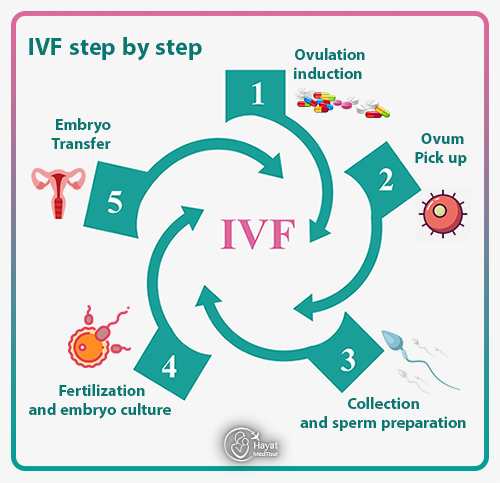
IVF (In Vitro Fertilization) is a common procedure, used to overcome a range of fertility issues. It is a multi-step process involving ovulation induction, egg retrieval, Collection and preparation of sperm, fertilization, culture, and embryo transfer. The IVF process can be explained in these five steps:
-
Ovulation induction
Fertility medications are prescribed to control the timing of the egg ripening and to increase the chance of collecting multiple eggs during one of the woman’s cycles. These drugs are used to stimulate the growth of several eggs in the ovaries. Normally, only one egg grows per month.
However, during the IVF treatment process, several eggs are needed. Because, after the fertilization phase, some eggs will not fertilize or they will not grow naturally. Induction ovulation drugs start from 8 to 14 days before menstruation and you should see your doctor every two or three days to check the ovulation condition. Depending on the case, normally the ovulation Induction procedure takes 10 to 20 days.
-
Ovum Pick up:
After the induction of ovulation and the development of suitable oocytes for fertility, the eggs should be retrieved for in vitro fertilization. Egg retrieval or egg ‘pick up’ is a hospital day procedure where the eggs are collected from your ovaries. An anesthetist will get you ready for a general anesthetic. Your fertility specialist uses the latest ultrasound technology to guide a needle into each ovary and inserts a very thin needle through the upper vaginal wall and removes fluid, which contains eggs, from the follicles of the ovaries. The average number of eggs collected is 8-15. The procedure usually takes less than 30 minutes.
-
Collection and preparation of sperm
The choice of the sperm collection method depends on the condition of the sexual partner. Semen is naturally sampled if the man’s sexual health is in good condition. But when the man is azoospermia and unable to give a sample, Semen samples are collected by the urologist using the PESA (semen testicular syringe under local anesthesia (or TESE method) direct testicular biopsy under general anesthesia). Learn more about the ways of increasing sperm quality and fertility in men: tips for boosting sperm quality
Then, the sperm are separated from the semen sample and washed in a specific manner. The Laboratory-washed sperms are tested to evaluate the sperm motility and shape in selecting the quality sperms. Selected sperms are transferred to the culture medium for fertilization. If sperm are collected sooner than the ovulation time; they are frozen until the fertilization time. Learn more about sperm problems and their effect on male infertility: Sperm problems in infertility
-
Fertilization and embryo culture:
After the ovum picks up, the embryologist examines the obtained egg to select mature eggs that are suitable for fertilization.
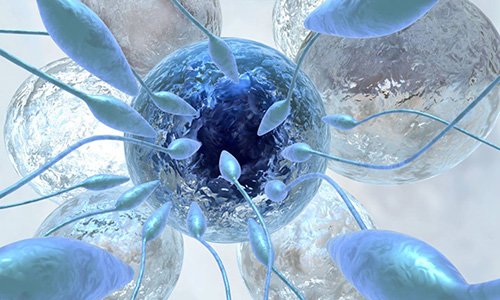
The mature eggs are placed in a culture medium and the sperm is transferred to an incubator for fertilization. In IVF, high-motility sperms move to the eggs and fertilize them. Once this occurs, the fertilized eggs are considered embryos.
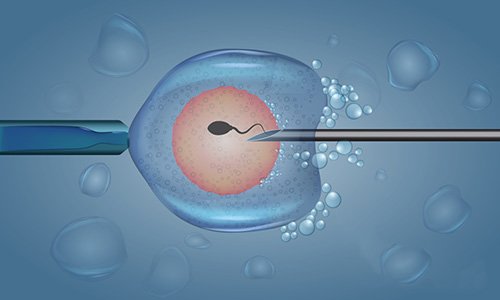
In conditions with a low number and low quality of sperm, the specialist uses intracytoplasmic sperm injection (ICSI). It is an additional part of an IVF treatment cycle in which a single sperm is injected into each egg to assist fertilization. If each egg is fertilized, the resulting cell begins to divide and reaches about 10 cells in 3 days. Finally, the embryo is transferred to the uterus within 2 to 5 days after fertilization.
-
Embryo Transfer
An embryo transfer is the last part of the in vitro fertilization (IVF) process. Around 2 or 3 days before the embryo transfer, the doctor will choose the best embryos to transfer to the uterus. Sometimes, there are “extra” embryos after an IVF cycle, and most people choose to freeze or cryopreserve their extra embryos.
The number of embryos in each IVF cycle depends on factors such as the age of the mother, the cause of infertility, and how the ovaries respond to drug stimulation in the treatment process. In each IVF cycle, between 4 and 15 eggs are usually obtained, and on average, about 50% of the eggs turn into embryos in the laboratory. Usually, two embryos are transferred to the mother’s uterus in each IVF cycle, and the remaining embryos are frozen and stored for transfer in subsequent cycles.
Embryo transfer is a simple procedure that does not require any anesthesia. Embryos are loaded in a soft catheter and are placed in the uterine cavity through the cervix. The procedure is usually painless, but some women experience mild cramping.
IVF Successful Rate
IVF success rates in Iran are comparable to those of leading fertility centres in Europe and North America. Iranian clinics report the following average outcomes per cycle:
| Patient profile | Success rate per cycle |
|---|---|
| Women under 35 — own eggs Highest chance | |
| Women aged 35–40 — own eggs | |
| Women over 40 — own eggs | |
| Women over 40 — donor eggs | |
| IVF with PGD — any age |
These figures are consistent with data published by the European Society of Human Reproduction and Embryology (ESHRE) for clinics of equivalent standard. Iran performs over 30,000 IVF cycles annually across more than 80 Ministry of Health-licensed fertility centres, giving its specialists a volume of experience that directly contributes to these outcomes.
The success rates are generally reported according to the woman’s age, since as a woman gets older, the IVF success rates go down. In spite of the female age, the couple’s lifestyle is an important factor in IVF success. Also, smoking and a stressful lifestyle are other negative factors affecting IVF outcomes. learn more about the most effective and helpful IVF success tips: Tips to Increase Your Chances of IVF Success
Learn more about smoking effects on fertility: Effect of smoking on fertility
Can you select the sex of the embryo in the IVF process?

The advantage of using IVF is that you can use complementary techniques such as pre-implantation genetic diagnosis (PGD) and microsorting for sex selection. The PGD technique helps couples who have a genetic disorder and allows them to have a normal baby.
In IVF and ICSI, it is possible to determine the sex of the fetus before transferring the fetus to the uterus by using the PGD technique. In this method, screening is usually performed before the transfer of the embryo to the mother’s uterus, and after the necessary examinations and tests, the sex is determined.
After embryo formation in IVF, a cell is isolated from the dividing embryo and subjected to genetic and chromosomal analysis. After determining the sex of the embryos, the embryo with the desired gender is transferred to the mother’s uterus. (Learn more about Gender Selection)
What are the pre-IVF assessments?
Couples who are undergoing IVF treatments should have a more precise evaluation. The evaluations are as follows:
-
Ovarian Reserve test
This test is valuable in predicting the response to induction ovulation drugs and may help the treatment plan. Learn more about analyses and tests to find out the cause of infertility in women: Analyses to find out the cause of infertility in women
-
Sperm analysis
This test can be used to analyze the number, shape, and motility of sperm. This test should be performed shortly before the treatment to obtain more accurate results. According to the result of this test, the doctor will decide whether to use IVF or ICSI for egg fertilization. Learn more about infertility tests for men: How to Check Fertility in Men
-
Screening for infectious diseases
This test examines both infectious and viral diseases in men and women to ensure the safety of the medical staff and laboratory personnel. In addition, this screening test can protect the IVF embryos against such infections.
-
Experimental transfer
This test selects the embryo transfer method and identifies the women who have difficulty in the embryo transfer process.
-
Imaging the uterine cavity
Uterine imaging is performed to ensure the uterus is ready for implantation of the embryo, a short time after the start of the treatment cycle. This method can detect embryo implantation disorder and adverse effects on pregnancy.
The post-treatment care in IVF
In general, the following instructions are advised for the posts IVF periods:
- Regular consumption of medications
- Avoid tense physical activity and exercise until 72 hours after the embryo transfer( daily activities are allowed)
- Do not use the bathtub or vaginal douche
- Avoid sexual intercourse for up to two weeks after the embryo transfer
- Avoid smoking and alcohol consumption
Learn more about what to do after the embryo transfer: How to increase implantation success after the embryo transfer?
What are the causes of IVF failure?
The success of IVF depends on the successful completion of each treatment stage. So, if one of the stages fails, IVF will also fail. Cases such as poor ovarian response to the drug in the early stages, poor quality of the retrieved eggs and sperm, genetic problems of the embryos formed, and uterine disorders can cause IVF failure (Learn more Egg Donation: Egg Donation in Iran). If IVF fails, couples can repeat the IVF process after 2 or 3 menstrual cycles. The reason for the delay is to give the woman time to return to her normal menstrual cycle. For more information about the reasons behind most IVF failures, you can visit: Causes of IVF Failure
What are the risks of IVF?
Any treatment may have risks. Therefore, before starting the IVF process, it is important to be aware of some of the risks of IVF and the issues that may occur during the treatment process.
The main risks of IVF :
- Side effects of IVF drugs
- Multiple pregnancies
- Ovarian hyperstimulation syndrome
- Complications of egg collection from the ovaries
- Ectopic Pregnancy
- Stress
Learn more about the risks of IVF treatment: The risks of IVF
Does the ovarian reserve decrease after doing IVF?
In general, studies indicate that ovarian reserve does not significantly decline in patients who undergo up to 3 repeated IVF cycles. However, when patients undergo more than three cycles, the results are unclear because age becomes an important factor.
The most important factor that affects ovarian reserve in patients undergoing IVF is age. Research suggests that multiple ovarian stimulations during IVF cycles with intrauterine insemination do not clinically impair the ovarian response.
What are the chances of multiple pregnancies in IVF?

The rates of multiple pregnancies following IVF remain high. The mother’s age and the number of transferred embryos in an IVF cycle are the factors that lead to multiple pregnancies.
The following table shows the percentage of single and multiple births in women under 35 years old, depending on the number of embryos transferred during IVF treatment. You can learn more about Multiple Gestation in this reference: Clinical Gynecologic Endocrinology and Infertility, 8th edition
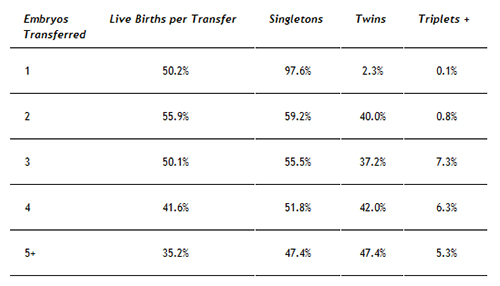
Live Births per Transfer and Percentages of Multiple-Infant Births for Women Under Age 35 with Surplus Embryos Suitable for Cryopreservation, by Number of Embryos Transferred. (Fritz, M. A., & Speroff, L. (2011). Clinical Gynecologic Endocrinology and Infertility. Lippincott Williams & Wilkins.)
IVF cost in Iran
IVF in Iran costs between $2,500 and $4,500 per cycle for a standard protocol — roughly 80% less than the same treatment in the United States or United Kingdom, and significantly less than Turkey or Spain. This price difference is not a reflection of lower standards. It is the result of Iran’s favourable exchange rate, government subsidies for fertility treatment, and a highly competitive private healthcare market that has driven up quality while keeping costs accessible.
| Country | Average cost per IVF cycle |
|---|---|
| United States | $15,000 – $20,000 |
| United Kingdom | $8,000 – $12,000 |
| Spain | $5,000 – $7,000 |
| Turkey | $3,000 – $5,000 |
| Iran — Hayat MedTour Best value | $2,500 – $4,500 |
| Iran — with egg donation | $3,500 – $5,500 |
| Iran — with PGD | $4,000 – $7,000 |
Iran vs Other IVF Destinations, Which Is Right for You?
Choosing where to have IVF abroad involves more than comparing prices. Here is how Iran compares against the most popular alternative destinations across the factors that matter most to international patients:
| Factor | Iran — Hayat MedTour | Turkey | Spain | Czech Republic |
|---|---|---|---|---|
| Cost per cycle Lowest | $2,500 – $4,500 | $3,000 – $5,000 | $5,000 – $7,000 | $3,500 – $5,500 |
| Success rate (under 35) | 45 – 50% | 40 – 50% | 40 – 55% | 40 – 50% |
| Egg donation legal | ✓ Yes | ✓ Yes | ✓ Yes | ✓ Yes |
| Surrogacy legal | ✓ Yes | ✗ No | ✗ No | ✗ No |
| Wait time to start | Days | Days | 1 – 6 months | 1 – 3 months |
| English-speaking staff | ✓ Yes | ✓ Yes | ✓ Yes | ✓ Yes |
| Dedicated coordinator | ✓ Yes | ~ Varies | ~ Varies | ~ Varies |
| Visa required | Medical visa — we handle it | ✓ Visa-free (most) | Schengen visa | Schengen visa |
| Cost with egg donation | $3,500 – $5,500 | $5,000 – $8,000 | $7,000 – $10,000 | $5,500 – $8,000 |
Iran offers the lowest cost per cycle of any established IVF destination, with success rates that are fully competitive with Spain and the Czech Republic, countries that charge three to four times more. The primary consideration for most international patients is the visa process, which Hayat MedTour handles as part of every package.
Every couple’s situation is different, which is why Hayat MedTour has put together two clear, all-inclusive packages, so you know exactly what is covered before you travel, with no hidden costs and no surprises on arrival. Whether you are starting your IVF journey for the first time or returning after a previous attempt elsewhere, both packages are designed to give you the best possible care at a price that is genuinely within reach.

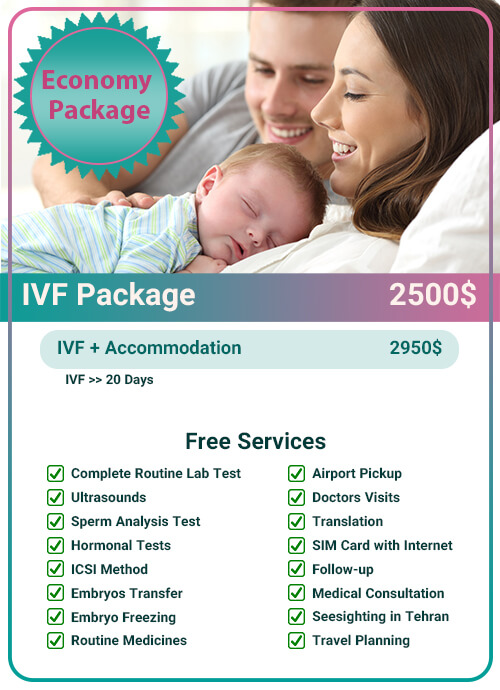
Learn more about IVF cost in Iran: The cost of IVF in Iran
IVF is one of the most effective infertility treatments in many authoritative and well-equipped medical centers in Iran. Hayat Medtour by facilitating travel to Iran and treating infertility in specialized centers accompanies you until you realize your dream and see your beloved child smile.
References:
Does the ovarian reserve decrease from repeated ovulation stimulations?
Frequently Asked Questions about IVF
What happens if my first cycle is unsuccessful?
An unsuccessful cycle is not the end of the road. If viable embryos were frozen during your cycle, a frozen embryo transfer can be attempted on a return visit at significantly lower cost than a full fresh cycle — typically $1500–$2,500. Your physician will review your response to stimulation and adjust the protocol for the next attempt. Many couples who do not conceive on the first cycle succeed on the second or third.
How long do I need to stay in Iran for IVF?
Most patients stay about 3 weeks for a complete fresh IVF cycle. The exact duration depends on how quickly your ovaries respond to stimulation, your coordinator will give you a personalised timeline before you travel, so you can plan your trip accurately. If you have frozen embryos from a previous cycle, a frozen embryo transfer (FET) requires only 10 days.
Do clinics in Iran have English-speaking staff?
Yes. All Hayat MedTour partner clinics have English-speaking medical coordinators. Additionally, Hayat MedTour assigns a dedicated interpreter to accompany you at every clinical appointment, ensuring nothing is lost in translation during consultations, procedures, or follow-up discussions.
Is there a problem with traveling after the embryo transfer?
After embryo transfer and resting for one to two hours in the treatment center, traveling is not prohibited. But it is recommended to take a short walk in the airplane corridor every hour and drink liquids. If you travel by car, it is better to get out of the car every two hours and walk for 15 minutes.
Is IVF in Iran legal for foreign nationals?
Yes. Iran’s Ministry of Health fully regulates fertility treatment for both domestic and international patients. IVF, ICSI, egg donation, embryo transfer, and surrogacy are all legal and widely practiced. Hayat MedTour provides all necessary documentation, including your visa invitation letter and clinic coordination.
Are IVF babies healthy?
Research shows that there are no abnormalities and fetal problems in babies born with IVF compared to normal pregnancies. In other words, fetal problems are the same in a baby born with IVF and a baby born with a normal pregnancy.
How many embryos are produced in one IVF cycle?
The number of embryos in each IVF cycle depends on factors such as the age of the mother, the cause of infertility, and how the ovaries respond to drug stimulation in the treatment process. In each IVF cycle, between 4 and 15 eggs are obtained after ovulation induction. About 50% of the eggs in the process of treatment become embryos and, according to the doctor’s diagnosis, some embryos are transferred to the mother’s uterus.
Does psychological stress affect the outcome of IVF?
Research published in journals including Human Reproduction suggests that while stress does not directly cause IVF failure, it can affect hormone levels and treatment compliance. Hayat MedTour provides a dedicated patient coordinator throughout your stay to reduce logistical stress, allowing you to focus entirely on your treatment and wellbeing.
Does hysteroscopy affect IVF outcome?
Hysteroscopy before IVF is not necessary. Unless the patient is a candidate for hysteroscopy due to uterine malformations. Performing hysteroscopy in candidate patients increases IVF success rate.
What is the difference between IUI and IVF?
IUI is one of assisted reproduction techniques in which washed sperm are injected directly into the woman’s uterine cavity. In the IUI treatment, by directly inserting man’s sperms into the woman’s uterus, travel to the Fallopian tubes becomes shorter and the probability of sperm contact with the egg increases, thereby increasing the chance of pregnancy and thereby fertility treatment. IUI is less invasive infertility treatment method. This method is generally used as a first step in the infertility treatment process, and if unsuccessful, depending on the couple’s condition the other treatments such as IVF & ICSI are suggested.
IVF is one of the assisted reproductive techniques which a man’s sperm and the woman’s egg are combined in a laboratory dish, where fertilization occurs. When the egg is fertilized, the primary cell begins to divide and form the embryo. The resulting embryo or embryos is/are then transferred to the woman’s uterus to implant and develop naturally. IVF is a more sophisticated method than IUI. This method is used in cases where multiple IUIs have not been successful.
What is the IVF success rate with endometriosis?
Research shows that IVF success rates in women with endometriosis are not much different from IVF success rates in other cases. Therefore, the success rate of IVF in women with endometriosis is about 40%. (learn more about endometriosis: Endometriosis and Infertility)
What should I do after repeated IVF failures?
The previous record of failed IVF cycles up to 4 cycles has no effect on subsequent cycles. But after 4 unsuccessful IVF cycles, the probability of successful treatment for infertility decreases. In such cases, it is advisable to use a donated egg or embryo or rented uterus if it is possible for the couple.
Is there an age limit for IVF treatment?
Mother’s age is the most important factor in determining the likelihood of IVF success. Increasing mother’s age to over 40 is associated with a severe decrease in IVF fertility, which is due to a progressive decrease in the ovarian response to stimulation, which results in fewer eggs and embryos. Also, as the age increases, the quality of the oocytes decreases. Learn more about ways to improve your egg quality: Ways To Improve Egg Quality For IVF.
How many IVF cycles will you need for a successful pregnancy?
Sometimes pregnancy occurs with the first IVF cycle. But if pregnancy does not occur, IVF can usually be repeated three to four times. However, there are cases where an infertile woman can get pregnant after more than four cycles of IVF.
What is the success rate of IVF in male infertility?
It depends on the severity of male infertility and the correct choice of treatment. If male infertility diagnosed truly and treated properly , IVF will have a high success rate in male infertility.
When is IVF used to treat infertility?
IVF is most definitely indicated when infertility is caused by one or more factors that are not effectively treated by other methods, severe tuberculosis due to previous infection or advanced endometriosis and severe male infertility, are the most obvious examples. IVF is also often the most important treatment for couples with age-related or unexplained infertility. IVF is the last option for women who have failed all other infertility treatments.
Can a postmenopausal woman become pregnant with IVF?
After menopause, there are no follicles in the ovary, so egg formation is not possible even with medication in IVF. But pregnancy by using a donor egg or donor embryo is still possible for postmenopausal women. A specialist physician can prescribe menopausal uterus for embryo acceptance and implantation by prescribing medications.
When is the best time for IVF and infertility treatment?
The best time for IVF and infertility treatment is when you are ready. It is recommended that you do not delay IVF and other infertility treatments for a variety of reasons. Because by delaying treatment and increasing age, your chances of IVF and fertility success are reduced.
So take the IVF and treatment for infertility as soon as possible.
What is the impact of endometrial scraping on IVF success?
Creating a scratch in the uterine wall can increase the chance of embryo implantation in the uterine wall and thus increase the chance of IVF success.
In this method, the endometrial lining is scraped superficially by a special tool. This local scratch causes an inflammatory reaction and increases the secretion of growth factors.
The timing of endometrial scraping is very important. The best time to scrape the endometrium is around the 20th day of the menstrual cycle. It is better to do this scratch one cycle before IVF and embryo transfer.
In what cases are the embryos frozen in the IVF process?
In an IVF cycle, after taking ovulation stimulating drugs, a number of eggs are removed from the ovaries and fertilized with sperm in the laboratory environment and embryos are formed. Then, after 5 days, the created embryos are transferred to the mother’s uterus.
But sometimes, for some reason, the specialist doctor may not transfer the embryos to the uterus in one cycle. In this case, the embryos are frozen for transfer in the next cycle. Conditions that cause embryos not to be transferred in the same cycle include:
- The thickness of the endometrium (inner layer of the uterus) is not acceptable.
- The uterus has lesions such as polyps, myomas, etc.
- In such a situation, the problem related to the uterus should be solved first, and then the embryo should be transferred.
- When the patient is at risk of ovarian hyperstimulation (OHSS).
- Increased progesterone hormone levels.
- Occurrence of vaginal bleeding during or before the embryo transfer.
In addition, sometimes, the number of embryos formed in one IVF cycle is high, and only a limited number of embryos are transferred to the mother’s uterus in the same cycle. In such cases, the extra embryos are frozen for use in the next cycles. The remarkable point is that the research shows that frozen embryos are not genetically different from fresh embryos. Therefore, freezing embryos has no negative effect on the success of IVF results.
Can same-sex couples or single women access IVF in Iran?
Iranian law requires IVF to be performed within a legally recognised marriage. Single women and same-sex couples are not eligible for IVF treatment in Iran under existing regulations.